Roof Leak in Elizabeth, NJ
A roof leak rarely starts where the stain shows. Water enters at a shingle, a flashing joint or a valley, travels along the deck and the rafters, and shows up inside feet away from the entry — on a ceiling, down a wall, or in the attic. Painting over the stain does nothing; the water keeps coming in at the same place.
Talk to a local roofing professional
One call connects you with a local professional for the Elizabeth area. Describe your roof — what you are seeing, and where — and the visit is arranged from there.
Mon–Fri 7:00 AM–10:00 PM ET · Sat 8:00 AM–10:00 PM ET · Sun 7:00 AM–9:00 PM ET
What causes roof leak on Elizabeth roofs
Four causes account for most Elizabeth roof leaks. Flashing that has separated from a chimney, a wall or a vent lets water in at the joint. A valley worn through lets water in where two slopes meet. A cracked pipe boot lets water in where the vent pipe passes through the roof. And a lifted or missing shingle lets water under the covering at the edge of the course. Each cause is found by the same trace — from the stain, along the deck, up to the entry.
The attic is where the trace is done. Daylight through the boards, damp on the rafters, and stained wood all mark the water's path, and the path leads uphill to the entry. A leak that shows on a hallway ceiling may have entered at a vent two courses up and three feet to the side. The attic shows the path; the ceiling only shows the end of it.
Time matters with a leak. Water that enters through the roof soaks insulation, stains ceilings, swells drywall and feeds damp in the attic that rots the deck from below. A leak left through a hail season becomes a deck repair, and a deck repair is a bigger job than the flashing fix that would have stopped it.
A leak is not always rain getting in. Warm, moist air from inside the house rises into the attic, and where it meets a cool deck it condenses and drips — a damp patch that looks like a leak and is not one. The attic check tells them apart: a rain entry leaves a path from a shingle, a flashing joint, or a valley, while condensation leaves damp across the deck with no entry above it. Bathroom fans that vent into the attic instead of through the roof are the usual cause, and the fix is airflow, not shingles.
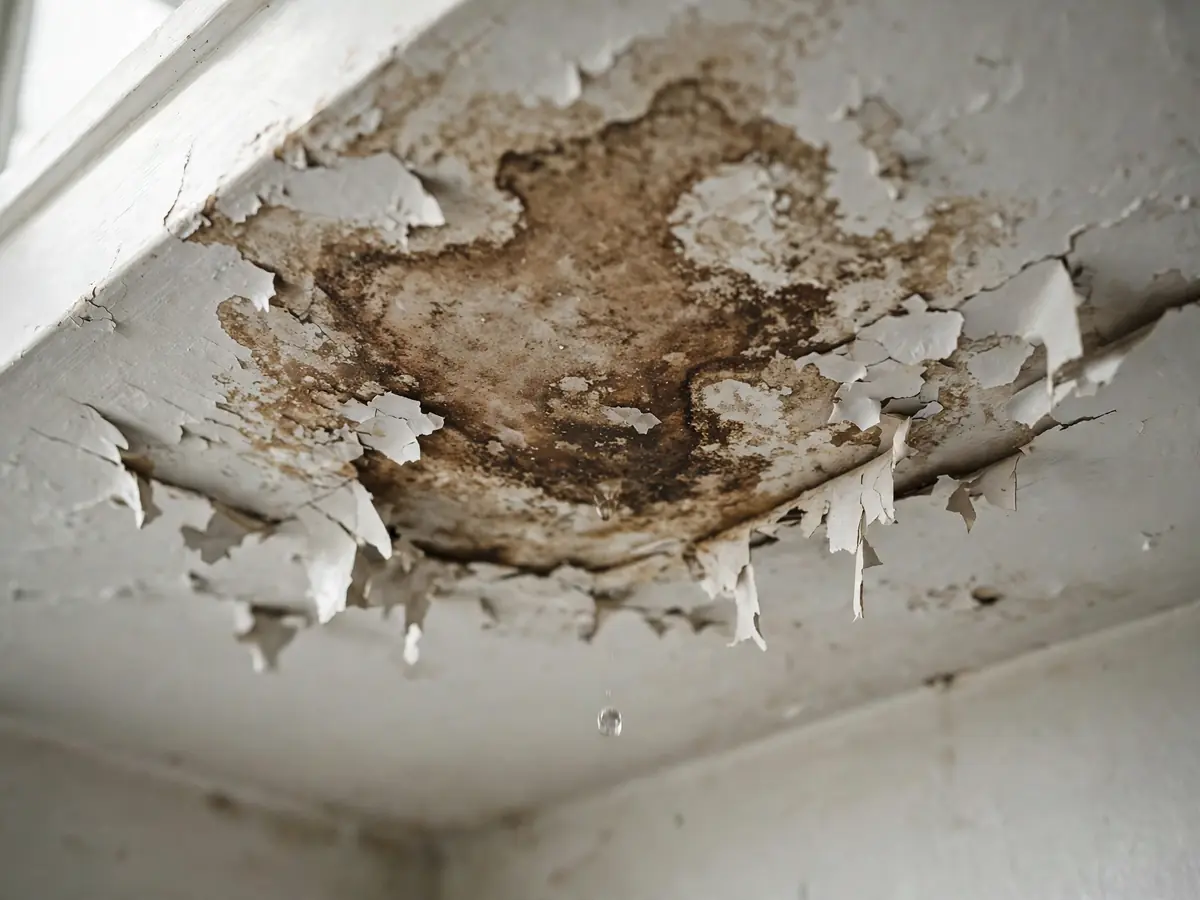
Signs of roof leak
A stain on the ceiling that grows after rain, a damp patch in the attic, a musty smell in a room that never had one, or paint bubbling on a wall below the roofline are the signs of a leak. Each one points to water getting in somewhere above, and each one is worth a look before the next storm — a stain that grows is a leak that is still open.
The sign that matters most is the stain that appears days after the storm. Water that entered through a lifted shingle travels along the deck before it shows inside, so a stain that appears late is still a storm leak. The roof should be looked at before the next storm, not after it.
How roof leak is fixed
The repair fixes the entry, not the stain. A separated flashing joint is re-shaped and re-sealed. A worn valley is cleared and re-lined. A cracked pipe boot is replaced. A lifted shingle is replaced in its course and sealed against the next wind. Each fix is checked from the roof and from the attic, and the visit notes say what to watch after the next rain.
After the repair, the attic is checked again for damp, and the room inside is left to dry. Wet insulation and drywall are pointed out so they can be dealt with as part of the recovery, because a roof repair that leaves wet insulation in the attic leaves a damp problem behind.
After the fix, the attic is checked again after the next rain, and the check is the real test. A dry attic after a heavy rain means the entry is closed; a stain that returns means the entry is elsewhere, and the trace starts again from where the water shows now. The visit notes say what to watch — a new stain, a damp rafter, granules collecting where the repair was made — so a slow leak is caught while it is still small, before it soaks the deck again.
The visit, step by step
Call and describe the stain
Say where the water shows — ceiling, wall or attic — and when it started. A leak after a storm and a stain that grows slowly point to different causes.
Trace from the stain
A local professional follows the water from the stain, along the deck and rafters, up to the entry point on the roof.
Name the cause
The cause is named — flashing, valley, vent or shingle — so you know what is being repaired and why.
Fix the entry
The entry is repaired in place: flashing re-shaped, valley re-lined, boot replaced, or shingle replaced and sealed.
Check after the next rain
The attic and the repair are checked after the next rain, so a slow leak is caught while it is still small.
Problem → solution
Problem
An Elizabeth home with a stain on the bedroom ceiling that grew after every heavy rain. The shingles above the stain looked sound, and the stain had been painted over twice.
Solution
The trace followed the water uphill to a separated flashing joint at the chimney, two courses above the stain. The flashing was re-shaped and re-sealed, and the attic was dry after the next storm.
Related to roof leak
Flashing leaks
Flashing that has separated from a chimney or wall lets water in at the joint. Re-shaping the flashing closes the gap.
Valley wear
Two slopes pour water into one valley channel, and the channel wears first. Re-lining the valley restores the run-off.
Pipe boots
A cracked rubber boot around a vent pipe is a quiet leak source. Replacing the boot closes it.
Lifted shingles
Wind lifts shingle edges and breaks the seal. Re-sealing the lifted course stops the next storm getting under it.
Frequently asked questions
Straight answers to the questions Elizabeth area homeowners ask most.
Water travels along the deck and rafters before it shows inside, so the entry can sit several feet uphill from the stain. The trace follows the water's path to find the entry.
Flashing that has separated, a worn valley, a cracked pipe boot, or a lifted shingle. The inspection names the cause for your roof.
A small leak can wait days, not seasons. Water inside soaks insulation and rots the deck, so a leak left through a storm season becomes a bigger repair.
Keep the area under the leak clear, note where and when the water shows, and do not climb on the roof. The notes help the inspection trace the leak.
Yes. Warm, moist air in the attic can condense on the deck and drip like a leak. The attic check tells them apart: a rain entry leaves a path from a shingle or flashing joint, while condensation leaves damp across the deck with no entry above it.
The entry was elsewhere, or a neighbouring seal failed after the repair. Water travels along the deck before it shows inside, so the trace starts again from where the water shows now — the cause is found the same way, from the stain uphill to the entry.
Roof Leak on your roof?
Call now — we will connect you with an independent local roofing professional for an inspection and a clear plan.
Call NowTalk to a local roofing professional
One call connects you with a local professional for Elizabeth, Newark and the metro around them. Describe your roof — what you are seeing, where the problem shows, and when it started — and the visit is arranged from there.
Mon–Fri 7:00 AM–10:00 PM ET · Sat 8:00 AM–10:00 PM ET · Sun 7:00 AM–9:00 PM ET
Service area
Elizabeth · Newark · Linden · Rahway · Union · Hillside · Roselle · Roselle Park · Bayonne · Jersey City
Elizabeth Roofing Pros is a referral service connecting customers with local roofing professionals; it is not itself the service company.